
Butterfly pattern
The Butterfly pattern:
- Is a reversal pattern
- It has four legs. (X-A, A-B, B-C, and C-D)
- It shows a trend reversal point.
- There are bullish and bearish versions.
HOW TO IDENTIFY THE BUTTERFLY PATTERN
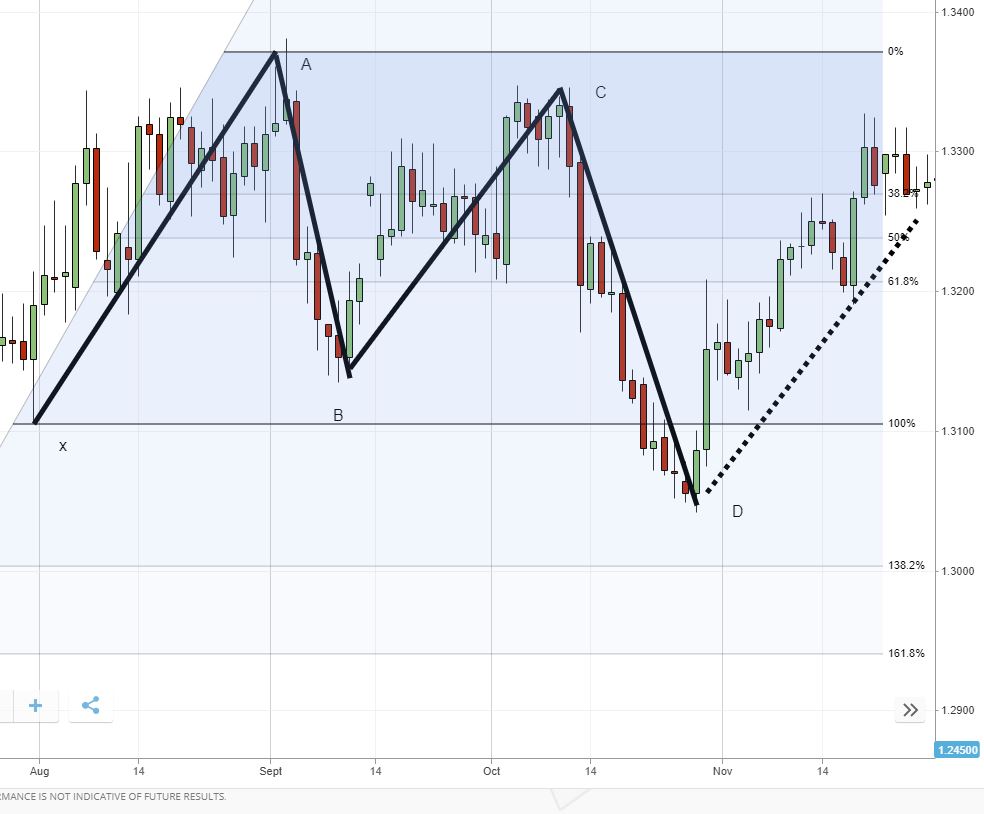
See the price chart below for an example of what a bullish Butterfly pattern looks like:

- Very similar to the Gartley or Bat patterns
- Four distinct legs are labeled X-A, A-B, B-C, and C-D.
X-A
The first leg forms when the price goes up sharply from point X to point A.
A-B
Change direction and retrace 78.6% of the distance covered by the X-A leg.
Please add Fibonacci to the chart to check!
B-C
Price changes direction again and moves back up, retracing 38.2% to 88.6% of the distance covered by the A-B leg.
C-D
- You would be looking to enter at point D of the pattern.
- Your trade entry order at the point where the C-D leg has achieved a 127% Fibonacci extension of the X-A leg.
Place your stop loss
Place your stop loss just below the 161.8% Fibonacci extension of the X-A leg, as below:
Place your profit target
I suggest opening a few positions at the same time with small amounts ( Or an equivalent big order if your broker allows partial close)
Take profits as bellow:
1st: Point B
2nd, 3rd, 4th, and 5th TPs at Fibonacci retracements of XA leg ( 61.8%, 50%, 23.6%)
Points C and A also can be selected.
Summary
- The butterfly is a reversal pattern
- It is similar to Bat pattern
- You should enter at point D
- Set the SL and TP based on Fibonacci numbers.